Driving With a Trailer
Speed limits:
Always keep to the legal speed limit for the road you are using.
Speed limits for cars towing caravans or trailers.
- 30mph limit applies on all roads with street lighting unless signs show otherwise.
- 50mph applies on single carriageways unless signs show otherwise.
- 60mph applies on dual carriageways and motorways.
It should be remembered that you must not travel in the outside lane of a motorway, with three lanes or more, if you are driving a vehicle towing a trailer.
Drive within your outfit's capabilities:
- Always drive at a speed that is well within your capabilities, and to the road and weather conditions that prevail at the time.
- If your trailer begins to snake or swerve, ease off the accelerator and reduce speed gently. (This can happen if you are driving too fast or the load in the trailer is wrongly positioned).
- Do not brake sharply on a bend, (this could cause a possible jack-knife situation). Reduce speed before the bend and take the appropriate gear for the speed you are doing. Then gently accelerate out of the bend.
Reversing with a Trailer:
- Before reversing, get out of the vehicle and check that all is clear to the rear before making the manoeuvre.
- Be on the look out for children and pedestrians. If possible, get someone to watch while the manoeuvre is made.
See deatiled "Step-by-step Reversing".
WARNING!! Never reverse a trailer without checking behind because of the huge blind spot. Ideally, have someone see you back, especially in crowded places.
Reversing a trailer is a skill that can be mastered with a little perseverance by anyone who has learned the basic theory. Find somewhere with plenty of space and keep trying until you get it right. It helps to have someone who knows how to do it to tell you where you are going wrong.
What weight can I tow with a car licence?
New rules introduced on 16th December 2021 allow anyone who passed their car driving test (Driving licence category B) from 1st January 1997 to tow trailers up to 3,500kg maximum authorised mass* (MAM).
This change is significant; up until now, anyone who passed their car driving test after 1st January 1997 has been required by law to pass a car and trailer driving test to tow a trailer up to 3,500kg MAM (within the towing limits of the vehicle). Drivers will now get Category BE added to their driving licence when they next get a new photocard driving licence and do not need to contact DVLA for this to happen.
Any person who passed their driving test before 1st January 1997 is permitted to drive a vehicle and trailer with a combined weight not exceeding 8,250kg
Regardless of the law change, employers are reminded of the need to ensure employees are competent to drive a car or van with trailer.
We strongly recommend new drivers and those who have not previously driven with a trailer receive professional training before driving with a trailer either for domestic or commercial purposes.
*Maximum authorised mass (MAM) is defined is the maximum weight of a vehicle or trailer including the maximum load that can be carried safely while used on the road. This is also known as gross vehicle weight (GVW) or permissible maximum weight.
Link to DVSA webpage: New rules for towing a trailer with a car from autumn 2021
How much weight can my vehicle tow?
It is important to refer to the Vehicle Identification Number (VIN) plate found on all cars and vans when identifying the weight limit of a vehicle, as this is the reference point used if a vehicle is stopped by authorities.
The VIN plate is usually found on the vehicle chassis, under the bonnet or on a door pillar, and contains several numbers as shown on the image below:
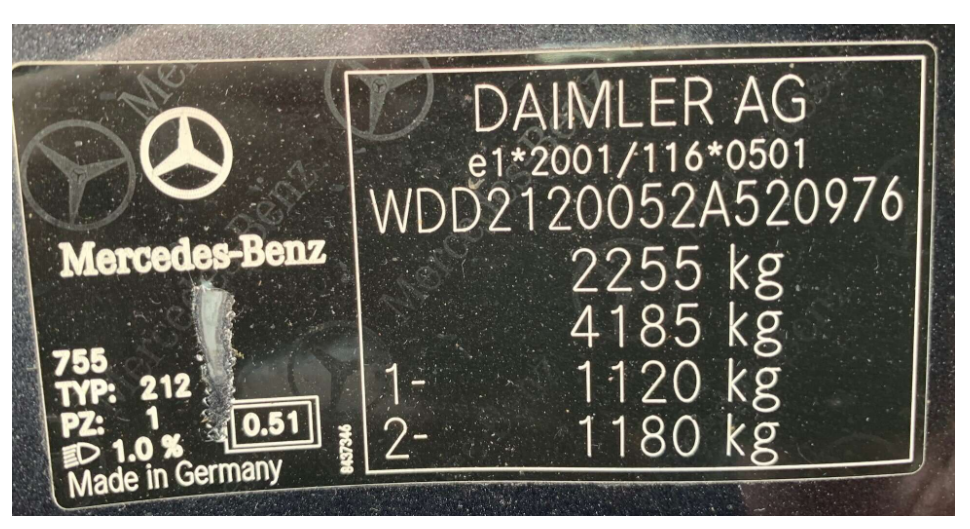
In the image above, there are 4 separate numbers:
2255kg: The Gross Vehicle Weight of the vehicle. This is the maximum weight of the vehicle when it is fully loaded with fuel, driver, passenger and cargo.
4185kg: Gross train weight, the combined maximum allowable mass of the fully-loaded vehicle and fully-loaded trailer. This figure must never be exceeded.
1120kg: Maximum permissible axle load (weight) on front axle
1180kg: Maximum permissible axle load (weight) on rear axle
The maximum towing capacity of a vehicle is calculated by subtracting the gross vehicle weight from the gross train weight.
Using the VIN plate in the picture above as an example:
4185kg - 2255kg = Towing capacity of 1,930kg (this figure includes the weight of the trailer and anything carried in the trailer)
The towing capacity of vans and cars varies according to body size, body type, drive-train and transmission, so always check the weight plate of whatever vehicle you are using carefully.
How much weight can my trailer carry?
Trailer manufacturers record the maximum trailer weight on the chassis plate of the trailer.
What size (dimension) trailer can I tow with my vehicle?
A towing vehicle with a gross vehicle weight of 3500kg or lower is restricted to the size of trailer it may tow. The trailer can be a maximum of 7m long by 2.55m wide.
How can I avoid exceeding the towing capacity of my trailer or vehicle?
Get your vehicle and/or trailer weighed at a weighbridge.